

So, let’s cut to the chase: there are still too few skilled, well-paid part-time jobs on offer. This was true even before the COVID-19 pandemic and remains true today. The default for too many job vacancies is full-time.
Before launching the Investing in Women job board, I worked as a corporate recruiter in London for 12 years. As mentioned on my About page, I’ve recruited hundreds of staff during my career. Not a single one was ever part-time.
This aversion to part-time work was my own experience when looking for a part-time job in the latter part of last year. I was regularly contacted by recruiters who wanted to interview me. As soon as I expressed a desire to work part-time, I was told the role was full-time. That part-time wasn’t an option, or worse, was ghosted. Why is there so much resistance to part-time work? This blog post will explore the history of the modern workplace and why, unfortunately, not much has changed for women.
The History of the Modern Workplace

The workplace evolved during the Industrial Revolution into something we recognise today. Before the Industrial Revolution, people predominantly lived and worked in the countryside. Many families worked together, tending to animals and bringing in the harvest. Other families (including the wives) worked together in the home. The hundreds of weavers’ cottages dotted around the Yorkshire villages I grew up in attest to that.
The Industrial Revolution and all its technological advancements changed our working lives forever. “The invention of mechanised cotton spinning moved the process out of homes and into factories. The large ‘spinning jennies’ and Mule spinning machines were worked by men, as strength was needed to operate them,” explains History Today. Women were starting to get nudged out of their place in the workplace…
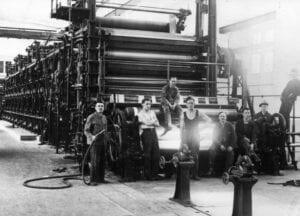
The Industrial Revolution brought millions of workers from the countryside into factory jobs in the cities. HR Technologists explain that the American Labour Unions devised the modern 9-5, eight-hour workday during this period. However, it was not until the 1920s that the eight-hour shift went mainstream. This was thanks to its adoption by Henry Ford, the innovator of Mass Production.
The Marriage Bar
Throughout this time, the Marriage Bar was prevalent throughout many Western societies. The marriage bar essentially called for the termination of a woman’s employment on her marriage, especially in teaching and clerical occupations. According to Wikipedia, widowed women with children were still considered married at times, preventing them from being hired. Many employers decided only to employ married women in temporary rather than permanent positions to avoid any embarrassing PR. By only using women temporarily, they could quickly terminate their contracts without too much scrutiny. These were the zero-hour contracts of their day!
Wikipedia adds that “Marriage bars generally affected educated, middle-class married women, particularly native-born white women. Their occupations were those of teaching and clerical work. Lower-class women and women of color who took jobs in manufacturing, waitressing, and domestic servants were often unaffected by marriage bars.“
Employers temporarily removed marriage bars during both World Wars as their male workforce was otherwise engaged. However, marriage bars were swiftly re-implemented as soon as peace was declared. Women were once again forced out of the workplace. It took until 1973 for the Foreign Office to finally lift its marriage bar.
Women NOT Supporting Women
Employers were not the only ones who discouraged married women from working. They often faced criticism from other women, too. Erin Blakemore for History Today writes that as the Great Depression pummeled millions of American workers, Frances Perkins, New York state’s Commissioner of Labor, warned that New York faced a particular threat from a surprising group: married women with jobs. “The ‘woman pin-money worker’ who competes with the necessity worker is a menace to society, a selfish, shortsighted creature, who ought to be ashamed of herself,” Perkins said. “Until we have every woman in this community earning a living wage…I am not willing to encourage those who are under no economic necessities to compete with their charm and education, their superior advantages, against the working girl who has only her two hands.”
 In 1970, the Equal Pay Act came into force to theoretically prevent discrimination, as regards terms and conditions of employment, between men and women. But, as we can see, for a large part of the 20th century, women did not feature in significant enough numbers within the modern workplace to enact this change. Men designed the workplace for men. Not just the ambience – in her book Invisible Women, Caroline Criado Perez tells us that most offices are five degrees too cold for women – but also the culture. In the corporate world, the long-hour culture is seen as a badge of success. And one that can only be achieved if someone plays a supporting role at home.
The Office Today
We are now 50 years on from the Equal Pay Act. The United Nations has warned that there is still a long way to go to achieve full equality of rights and opportunities between men and women. Only in December 2019 did People Management report that the UK had slipped down the global gender equality rankings. This was largely because of inequality in the workplace and a persistent gender pay gap. There are genuine fears that because redundancies made during the pandemic have disproportionally affected women, this will reverse any progress made regarding sexual equality in the workplace.
Why do many employers place so little value on their part-time workforce? Is it because it is predominantly made up of women, and because, throughout history, women’s work has been undervalued by society? The World Economic Forum published an article in 2016 titled The simple reason for the gender pay gap: work done by women is still valued less. They state that as women start moving into traditionally male-dominated positions, the pay falls: “A 10% increase in proportion female is associated with .5% to 5% per cent decrease in hourly wage in each decade.“
The Part-Time Penalty
We are now five years from the publication of that article. We have collectively experienced another industrial revolution since. Employers have had to adapt to allow their entire workforce to work from home quickly. Many businesses have reported no loss of productivity. The cynic in me wonders if the whole ‘working from home’ experiment has been declared a triumph because men and women were equal participants. Despite this apparent success in remote, flexible working, employers still lock mothers out of the workplace by failing to consider their part-time working requests. By blindly focusing on making full-time hires, are they not operating a marriage bar in all but name?

Full-time jobs discriminate against those with caring responsibilities and mothers who want to balance a career with time with their children. I am disappointed that many employers automatically discount part-time and job-share working requests without considering them. There are benefits to working part-time, not only for employees but also for employers, too. This is why I love Pregnant Then Screwed’s petition Flex for All. They are petitioning to change the law, so employers MUST publish flexible working options in job adverts or justify why the job can’t be done flexibly. I love this and genuinely think this would flip an employer’s thinking.
So my hopes for the future are this: employers, please do not automatically discount part-time. More part-time work is key to closing the gender pay gap. My blog article, How does flexible working benefit YOUR business, aims to convince you why part-time jobs make good business sense for you, too.
And if you are looking for a part-time job, check out the latest jobs on the Investing in Women job board. We work exclusively with the UK’s most family-friendly employers. All jobs advertised are guaranteed to offer flexibility to suit you and your family.