

Guest blogging is one of the most popular and efficient ways to gain trust, make your brand visible online, build authority, improve SEO, and expand your network. But once you start doing it, it often turns out to be more complicated than it seems.
That’s why in this guide, we’ve covered everything women entrepreneurs need to know about this tactic to help you make the most of it.
Let’s find out what this strategy is all about and what you should and shouldn’t do when guest posting.
What Is Guest Blogging?
In simple words, guest blogging means writing and publishing an article on someone else’s website. Instead of posting content on your own site, you submit a guest post to another blog that already has an audience.
In return, you usually get a backlink to your business website and exposure to new readers.
The process typically looks as follows:
- You search for relevant websites in your niche that accept guest contributions.
- Pitch them your content idea,
- Write your blog post and add your link naturally,
- Address any feedback and wait for publication.
Most beginners often have the most difficulty finding pages that accept guest posts. So, how do you do that?
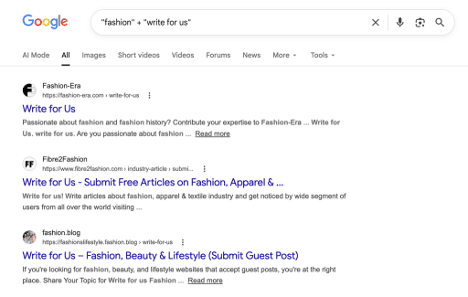
- Google: Search for your niche (or your keyword and communities you can relate to, like “women entrepreneurs”) + “write for us” (or “submit a guest post,” “guest blogging,” “guest posting,” “contribute,” etc.). Many websites openly advertise that they accept guest posts
- Study industry publications: Some platforms don’t publicly say they accept submissions. But they clearly feature guest contributors. If articles have different authors who work at different companies, that’s a signal for you to knock and offer your article
- Analyze your competitors: You can take any SEO tool and check where your competitors or related brands get their backlinks from. If those are contextual links in articles, most likely they’re guest posts.
Once you identify potential websites, organise them by website name, niche, editor name, contact email, writing guidelines link, etc. This list will serve as the foundation for your guest posting outreach strategy.
Benefits of Guest Blogging for Women Entrepreneurs
Guest articles can attract much more attention to your site, but that’s probably the most obvious advantage you can get. Let’s take a look at the rest of them.
Reach a Wider Audience
When you post your articles on other blogs, you automatically get introduced to another brand’s audience. And that’s a huge advantage when you want to increase your visibility and exposure.
For example, if you want to write about women investors, including yourself, it would make sense to pitch it to a startup-focused website that already attracts founders, VCs, and business professionals. This way, your insights will land directly in front of people who care about your topic.
Build Quality Backlinks and Improve SEO
Each time your guest blog post includes a URL that leads to your website, you gain a backlink. Backlinks are one of the strongest ranking factors in search engines. But, of course, it doesn’t mean you have to chase just any links.
You need relevant, high-quality links from credible sites. They bring you more value, as they signal trust and authority to Google.
After getting those quality backlinks, you will see the results like these:
- Your website will rank higher.
- Your blog posts will get more organic traffic.
- Your business will become easier to discover online (both in traditional search engines and AI search).
Establish Your Expertise and Authority
Getting published on established pages positions you as an expert. And the more your audience associates you with other credible names, the more it will rely on your opinion and actually trust your insights.
You can literally show that you’ve been featured on XYZ websites, and that is already valuable social proof.
Build Supportive Industry Relationships
This part is often underrated, and people tend to forget how important it is to have. Through guest posting outreach, you connect with editors, content managers, other contributors, and often founders.
As a result, these relationships can lead to:
- Partnerships and collaborations,
- Podcast and event invitations,
- Speaking opportunities,
- Cross-promotions, etc.
As a woman entrepreneur, you most likely know that building a strong support network can be just as valuable as building traffic.
6 Do’s to Start Guest Posting
Are you ready to reach out to another website to publish your article? Then, here is what you should start with.
1. Select High-Quality Pages Only
There’s a simple rule: one strong publication is worth dozens of weak ones. So, always review the quality of your prospects. A high-quality site has:
- A clear niche that is relevant to your topic,
- Valuable and human-written content,
- Real engagement with at least some activity and organic traffic,
- Professional design and no random pop-ups or fishy topics.
If a website looks spammy or publishes unrelated articles, there is no reason for you to contact them.
2. Master Pitching and Personalisation
Your pitch email is your first impression. Similar to how you’d pitch anything in business, you have to take this one seriously as well. Here are simple rules you can follow:
- Avoid generic messages.
- Show that you’ve done your research and know who you are talking to.
- Mention a recent article they published and explain why your topic fits their audience.
- Keep it concise but thoughtful.
Strong guest posting outreach is targeted and intentional. Most likely, it won’t be successful at the first try. But don’t get discouraged: it’s normal. Instead, simply experiment and note what works.
3. Learn Basic Cold Email Outreach Practices
Most of the guest article pitches you send are cold outreach because you don’t really have any prior introduction.
Now, imagine: editors receive dozens of cold messages. So, simply sending a basic email like, “I want to write for your blog,” won’t work in most cases. Instead, think of what makes you special and what the website editor might really want.
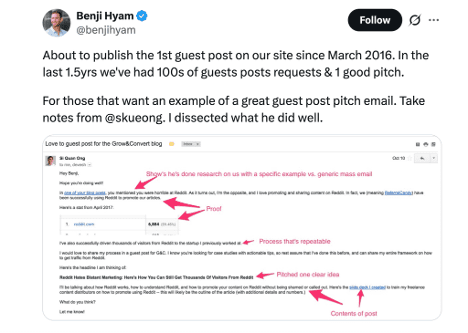
Here is a great example of how a website owner accepted only one pitch in 1.5 years. What was so special about this pitch
-
- It showed that the person has done their research,
- There was proof of their expertise,
- The author has added a clear title and content suggestions
4. Make Sure You Understand the Target Audience
Before drafting your guest article, go through the website carefully. Who are they speaking to? Beginners? Pros? Corporate leaders? Freelancers? Who is their target audience, and what do they know about your topic?
Your tone, content, and examples should match what their readers expect. If you do that, acceptance rates will be much higher, and your content will get more impactful.
5. Write Quality Content That Represents You
Every guest post represents you. So, don’t treat it like just a backlink opportunity. Consider it your space to express how you think. Offer real insights and add cases from your own experience. Let your personality out.
Additionally, ensure your content creates an exceptional experience for readers. Yes, UX isn’t just about design. Each blog post has to be organised and written in a user-friendly way.
6. Remember About the SEO Elements
Following SEO best practices is a must when guest posting. If we were to highlight the most important elements, these would be:
- Anchor text (the clickable words in a link) should feel natural. If you don’t know what anchor to pick, choose your brand name or a generic phrase like “these are some of the options,” “find more details here,” And don’t overuse keywords here.
- Optimise your guest post with relevant keywords. Simply spread them throughout the article and headings.
- Link to your strongest content. Not every page on your website deserves a backlink. So, choose your homepage, articles with strong organic traffic, important business pages, etc.
6 Don’ts to Avoid When Submitting Guest Blog Posts
In addition to knowing best practices, it’s also important to avoid guest blogging pitfalls. Let’s look at some major don’ts that can save you tons of time and effort.
1. Choosing Irrelevant Pages
Relevance is one of the most important things for this tactic. If your business supports female startup founders, publishing on unrelated entertainment blogs will have zero value for you.
So, stick to the sites that make sense for your niche.
2. Sending Generic Pitches
Mass emails destroy trust, no matter what you do after that. Editors can recognise copy-paste guest posting outreach, and that will affect your reputation later. You don’t want that.
So, better send fewer emails but more personalised. This way, you will have a much higher response rate.
3. Ignoring the Guidelines of Your Target Website
Guidelines are important for blending with the style of the page you are submitting your writing to. So, if the website provides submission rules, follow them carefully.
And if the editor doesn’t send you any guidelines, ask for them. This will save you from all the unnecessary back-and-forth later on.
4. Submitting AI-Generated or Plagiarised Content
Yes, knowing AI basics (at least) is crucial these days. Besides, when it comes to content creation, it can be quite useful, helping you with outlines, idea structuring, etc. But don’t use it to write your articles instead of you.
How many people want to hear the same, robotic voice?
Don’t make your readers think, as The NYT’s Sam Criss put it, “Something is wrong here; this text is not what it says it is. It’s one of them.”
Generally speaking, submitting AI-generated or plagiarised blog posts can do nothing good for your reputation. Unique perspectives belong to humans. Especially for women entrepreneurs, you have so much valuable experience, insights, and stories. Others want to hear about them, so go on: share your view.
Besides, most website owners run every submission through AI checkers anyway.
5. Making Your Guest Posts Too Salesy
Of course, writing a guest blog post is already a kind of advertising. But if you make it too promotional, you won’t get the results you want:
- Most website owners won’t accept an article like this.
- And their audience won’t appreciate the content because who likes being sold to?
So, always lead with value.
6. Not Staying in Touch With the Editor
Has your article gone live? Amazing! You achieved your goal, but don’t end it all here. Stay in touch with the website editor/owner:
- Thank them and connect on LinkedIn or other social platforms,
- Share the post through your channels,
- Ask if they’re open to future collaborations, or whether they have any partner websites that you could write for as well.
Long-term relationships lead to more opportunities. And that’s how you build a credible and powerful brand in the long run.
Conclusion
There are so many benefits of guest blogging that at least trying it once is a must. It might seem complex at first. But once you know how to do it right and what to avoid (and now you do), it becomes much easier to achieve tangible results.